Published on:
•
Last Updated:
When it comes to writing, designing and printing accessible books that can be read by a wide range of book-lovers, one way to open up your market of readers is by making a large print or easy read book. Large font and a clear layout of a large print book or an easy read book means that not only will your text be accessible to readers with vision impairments or those who are not as familiar with English, but it also broadens the access to anyone who prefers to read in this way.
What Is An Easy Read Book?
To put it simply, an “easy read” book is a version of your publication that is easier to read for a wide range of people. Accessibility is key when creating your easy read book - it’s important to consider the audience you’re writing your book for, and what accessibility obstacles may need to be overcome for the most amount of readers to enjoy your text. This might be readers who are not familiar with English, who have low literacy or comprehension levels, or readers with a learning or physical disability.
While a large print book refers to a copy of your publication in which certain adjustments have been made to make the writing larger and more readable, an easy read print has a few extra suggested guidelines. Easy read books, according to the Australian Government, present information via a unique layout and style so that it’s easier for readers to not only read, but also comprehend and understand the meaning behind the words. This means that images might be added to complement the text and the writing itself might be edited to reflect the same meaning and intention in simpler language.
What Is A Large Print Book?
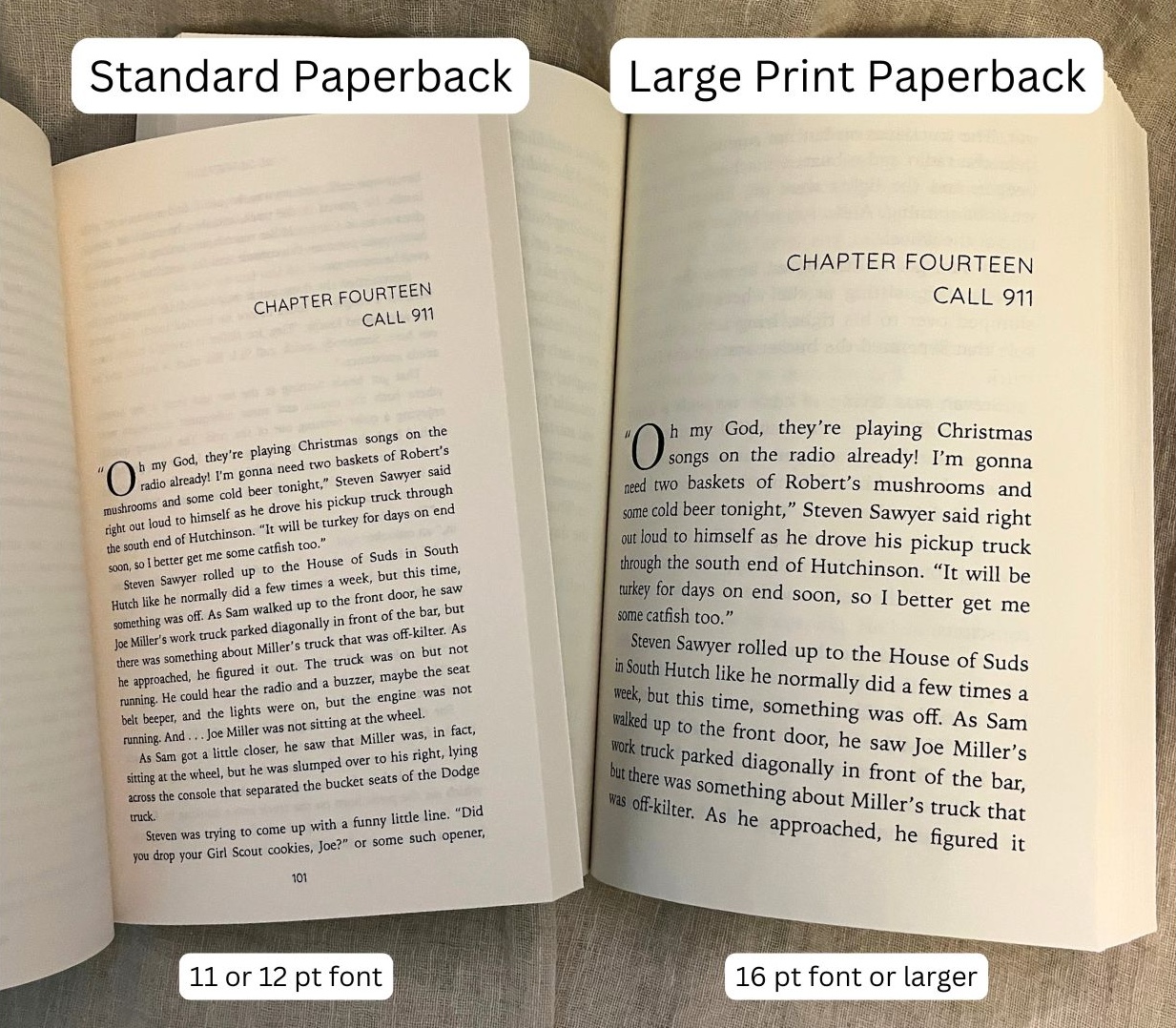
A large print book differs slightly from an easy read book. Whereas an easy read book is often used for folk who are less familiar with English or have trouble reading and understanding text, a large print book is more compatible with readers who struggle with typical-sized fonts and the layout and style that is usually used in book printing.
Large print books aren’t just about blowing the font up a few sizes, though. There are a few other suggested guidelines to keep in mind when designing and printing your large print book, and many of these can be used in combination with an easy read designed text, so you can open up the accessibility of your market of readers even wider.
How To Design Your Easy Read Book
The key thing to keep in mind when designing your book as an easy read copy is that the content and language needs to be able to be read between a Year 4 and Year 6 reading level, according to the Australian Government guidelines. More Australians than you might think have limited literacy - approximately 14% of Australian adults read below a Year 6 reading level, according to Inclusion Australia. It’s important to use simple words and grammar when constructing the text, but if your book is intended to be read by an adult audience make sure not to fall into the trap of using childish language. Follow the steps below to turn your own text into an easy read publication.
- Focus the language around simplicity
- Use both text and images to express the content’s meaning, and place images on the left to align with text on the right
- Utilise a large font size for body text; 14-point or above is recommended
- Use even larger font sizes for headings as well as make them bold, with the most important headings the largest
- Make use of wide margins and plenty of white space
- Utilise at least 1.5 line spacing
- Don’t use childish language if your intended audience isn’t children
- Write difficult words (words with three or more syllables) in bold and follow up the difficult word with a definition
- Include a glossary at the end of your book to explain difficult vocabulary
- Limit the use of questions to headings as opposed to throughout the text
- Test your book with a support network of professionals and people who read easy read texts
Other Easy Read Book Printing Tips
Once you’ve designed your book according to the easy read guidelines, it’s time to print it. This stage of bringing your book to life also has its own set of suggestions to make it easy for folk to read your book. Follow the tips below when you get to the printing stage of your project.
- Ensure paragraphs and sentences are not spilt across pages
- Page numbers should be included on all pages, and in the same size font as your body text
- Print your book on matt paper stock to reduce any glare off the page
- Offer your book to readers in a PDF format in addition to a printed format, as different readers prefer different styles of reading materials
How To Design Your Large Print Book
On the other hand, crafting a large print book is less about adjusting the meaning of the content and more about adjusting how it looks on the page. Large print versions of books are helpful for readers who may struggle with regular sized fonts, whether it be because of a vision impairment, a learning or physical disability or anyone wanting to spend some time reading a book without straining their eyes to see. Have a look at the below suggested guidelines for designing your project as a large print book.
- Utilise an 18-point sans serif point for ease of reading
- Ensure that headings and titles are sized even larger than the body text, as well as in bold
- Line spacing should be 1.5 or higher
- Include extra space between paragraphs
- Keep the spacing between words even by using ragged right text (aligning text lines against the left margin and letting it hang naturally at the end of the line on the right) as opposed to justified text
- Utilise bold instead of italics when expressing emphasis on particular words
Other Large Print Book Printing Tips
After you’ve taken all the design suggestions into account when crafting your large print book, next you need to set up your project for printing. Read on below to find out what kind of considerations to keep in mind to successfully print your large print book.
- Select a large trim size
- Print your book on matt, satin, silk or uncoated paper stock to reduce any glare off the page
- Consider paper that has a heavier weight to ensure the pages aren’t transparent and the text doesn’t bleed through
- Utilise binding that creates a flat spine so that the book can remain open when resting
Keep this simple guide handy next time you’re writing, designing and printing an accessible book. Whether it be in the style of an easy read book or a large print book, printing a book that is readable invites a wide range of readers to your project - and who doesn’t want that!
For more information on creating accessible books, we also recommend reading the latest edition of Books without Barriers from the The Institute of Professional Editors Limited (IPEd).
To learn more about our book printing services for self-published authors and get started on your writing journey, get in touch with our team today. We're here to help you navigate the evolving world of accessible indie book printing with confidence.