
Published on:
•
Last Updated:
There’s more to crafting an accessible book than meets the eye. Accessibility is all about inclusivity, and there are plenty of ways to print and self-publish your book that will make it a successful and enjoyable reading experience for all your readers, no matter their needs or preferences. Plus, the more all-compasing your book’s accessibility level is, the wider the range of audience that will read it - improving your book’s accessibility isn’t just a smart decision for inclusivity, but for business too. Follow this guide to learn about all the tips and tricks you can implement when putting together your own accessible self-published book.
Why You Should Diversify Your Book’s Format
One of the simplest ways to make your self-published book accessible to a wide variety of readers is to publish your book in a variety of formats. This means that alongside printing your book as a parcel of bound pages, you can extend its accessibility by also publishing a digital version of your book (e-book) and an audiobook version. In other words, you’re creating different ways for your book to be read.
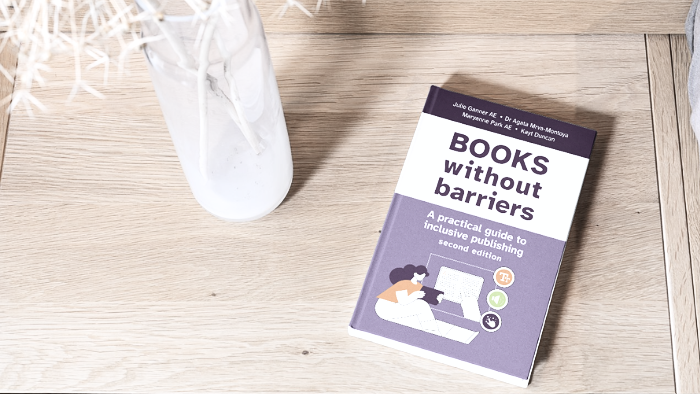
According to the accessible publishing guide Books Without Barriers by the Institute of Professional Editors, “The accessibility of a publication depends on how suitable and easily adaptable it is to the different ways in which people read. Publications that meet the needs of people with print disability are inclusive because they offer an equitable reading experience to all readers, irrespective of how the person accesses the content.” Print disability can mean visual (including blindness, low vision and medical conditions), perceptual or related to learning difficulties (caused by conditions such as dyslexia and autistic spectrum disorder), or physical (for example, conditions that make it difficult to manipulate and interact with printed materials or to focus or move the eyes).
How You Can Diversify The Accessibility Of Your Book’s Distribution
A printed book isn’t the only medium in which your self-published work can be read. Hearing or auditory reading allows people with print disability to engage with options like screen readers, text-to-speech software and digital recordings.
In simple terms, screen readers and text-to-speech software reads your book out loud through synthetic speech, allowing for users to adjust and adapt the software to their specific needs. A lot of smartphones, tablets and computers already have built-in screen readers, otherwise these software programs can also be downloaded. Alternatively, providing your audience with a digital recording of your book - like an audiobook - allows readers with print disabilities access to your story like anyone else. To ensure the accessibility of an audiobook, it’s important to remember that an audiobook should provide readers a similar level of information and flexibility to that enjoyed by readers of printed books.
Utilising the sense of touch through tactile reading is another way to provide an accessible reading method to readers with print disabilities. This could include braille, raised printing and three-dimensional printing. It can also be a good idea to combine text and braille when publishing your accessible book so as to create a shared reading experience, especially if you’re crafting a book with younger readers in mind.
For readers whose reading happens via sight, there are also a range of ways to elevate this experience and provide a wide berth of readers with assisted or alternative ways to sight-read. For example, distributing your book as a digital e-book can be an alternative means of interacting with your text for readers who - because of physical disabilities, low vision, colour blindness, dyslexia, or other limitations - may struggle to hold, handle or see a printed copy of your book. Printing your book in large print can also be another way to assist readers with low vision.
- Publish your book as a digital e-book
- Publish your book as an audiobook
- Consider publishing a version of your book that uses large print text, braille, raised printing or three-dimensional printing, especially for younger audiences
Large Print or Easy Read Books
If you're familiar with your local library, you may have noticed that many carry large print editions. These are copies that have been formatted under different guidelines including using a larger font size and clearer layout - so it's literally the same book with the content made larger. These books are also not only for readers with vision impairments but are popular in libraries from a range of readers who prefer to read larger text. This could be because they're younger (that's usually why children's books have larger text), struggle to focus on small text, have dyslexia, are still learning the book's written language or their eyes are easily strained from digital screen fatigue. In Australia, the large print books can sometimes be referred to as 'Easy Read' books. You can find the guidelines for formatting an easy read book from the Australian Government style manual here.
Writing And Editing Elements To Consider For Accessibility
There are a number of ways to improve the accessibility of your book through language via writing and editing. It’s vital to consider these adjustments in the drafting stage of crafting your self-published book so as to limit the need to go back and make dramatic changes at the end of the process.
Did you know that accessibility can be achieved through language itself? Writing in language that is appropriate for your audience is vital in forming a connection with them through your work. For example, there’s no point in using complicated words and complex ideas in a children’s book - neither the reader nor you will have a successful experience in connecting to the material that way.
Structure & Hierarchy
It’s not just the choice of language in your work that can help improve your project’s accessibility, but also how it is presented on the page. Structure and hierarchy are both vital elements of page structuring to consider when creating your book, as things like headings, lists and body text will - when used correctly - organise the information on the page in a logical manner. Headings are helpful in the hierarchy of information they inform the reader with, and they should be descriptive, clear, short and distinct, conveyed in size from biggest to smallest depending on the importance of information.
Typefaces (aka Fonts)
Selecting an accessible typeface will also help a whole swathe of readers have a more enjoyable experience with your book. While the jury is still out on whether sans serif is more accessible than a serif typeface (familiarity, space, size and contrast tend to matter more than serif versus sans serif), some of the typefaces (or, fonts) you can consider to design your book with include Georgia and Sabon for serif fonts or Calibri, Verdana and Tahoma for sans serif.
Semantic Tagging
Semantic tagging is another helpful technique in making your book an accessible read for everyone. Semantic tags are “digital labels that convey meaningful information about the elements enclosed between the opening and closing tags”, Books Without Barriers explains. Basically, these tags allow assistive programs to portray the document’s structure and tone to non-visual readers. For example, a screen reader might change its tone of voice when text is tagged as strong, to reflect a word written in bold.
Some other accessibility elements to look out for are to avoid stylising text in all capital letters (these can be hard for people to read), to watch out for over-relying on bold and italics (these can be difficult for readers with low vision, and especially braille users), always explain acronyms the first time they are used (some screen readers may not recognise acronyms as such), double quotation marks improve readability, and also numerals are easier to read for most people, including braille users, so keep this in mind if your book utilises a lot of numbers.
- Consider accessible language edits
- Utilise structure and hierarchy elements when organising headings, lists and body text
- Select an accessible typeface
- Use semantic tagging
- Don’t style text in entirely capital letters
- Do not rely on bold or italics
- Explain acronyms on first use
- Use double quotation marks
- Consider using numerals instead of written numbers
Printing Tips To Improve Your Book’s Accessibility
Now that you understand the significance of crafting an accessible self-published book and you’ve written up your work and designed it to be read by readers of all accessibility needs, it’s time to start thinking about what the printed version will look like! There are a few easy tips and tricks to apply to your printed book to ensure it’s a smooth and enjoyable read for everyone.
Books Without Barriers recommends using matt, satin, silk or uncoated papers when printing your book as these paper types help cut down on glare, making the reading experience a better one for all readers. Using glossy papers for the entirety of your book can cause the light to reflect off the surface and obscure the print. Additionally, it’s important to use paper with sufficient weight so that the printed text doesn’t show through on the other side of the page and interfere with the reading experience. Lastly, it’s a good idea to print your book with binding that allows for the book to open flat, so that readers of all accessibility levels can comfortably sit with your book and move through it at their own speed.
- Consider matt, satin, silk or uncoated paper to print on, and avoid glossy papers
- Utilise paper with sufficient weight
- Use binding that creates a flat spine
Ultimately, creating an accessible self-published book doesn’t just allow for a wider range of people to be able to read and enjoy your work, but it also undoubtedly makes the reading experience more enjoyable for anyone who gets to feast their eyes on your work. Following these simple tips will set you on the right path to crafting a successful reading experience for all.
To learn more about our book printing services for self-published authors and get started on your writing journey, get in touch with our team today. We're here to help you navigate the evolving world of accessible indie book printing with confidence.