Published on:
•
Last Updated:
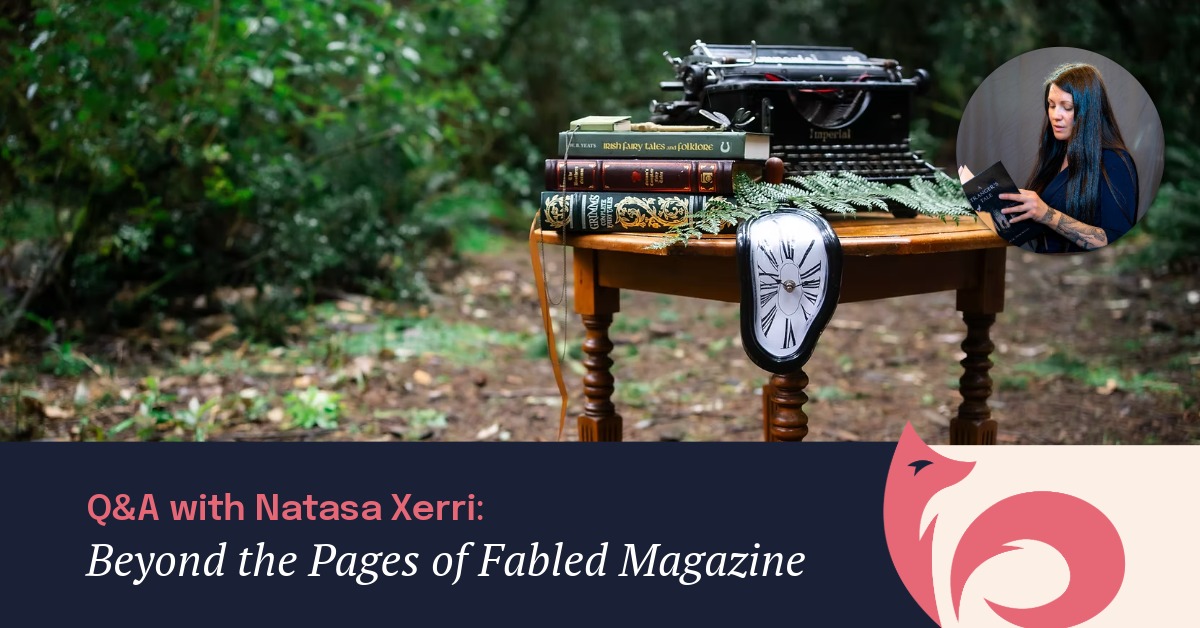
Whilst we spend our days printing books, magazines, and other literary works, it’s always fun to get a deeper look into the why behind a book, and a certain fairytale lore-driven publication instantly caught our attention. In case you haven’t seen them before, Fabled Magazine is an Australian biannual print and digital magazine dedicated to all things folklore, fantasy and fairytales, from local indie writers and contributors.
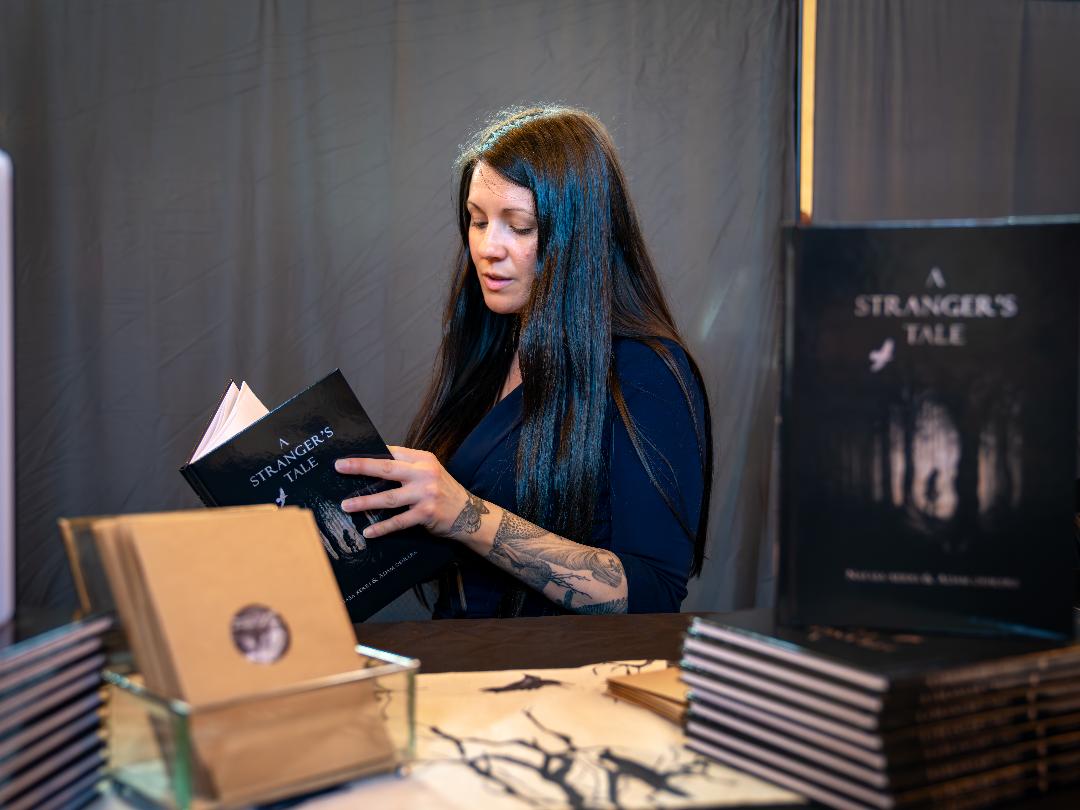
Founded by published author, Natasa Xerri, Fabled Magazine has solidified itself as a publication that’s all about sharing original content (absolutely no AI) to inspire, enchant and provoke thought, by showcasing works from a range of diverse voices and storytellers.
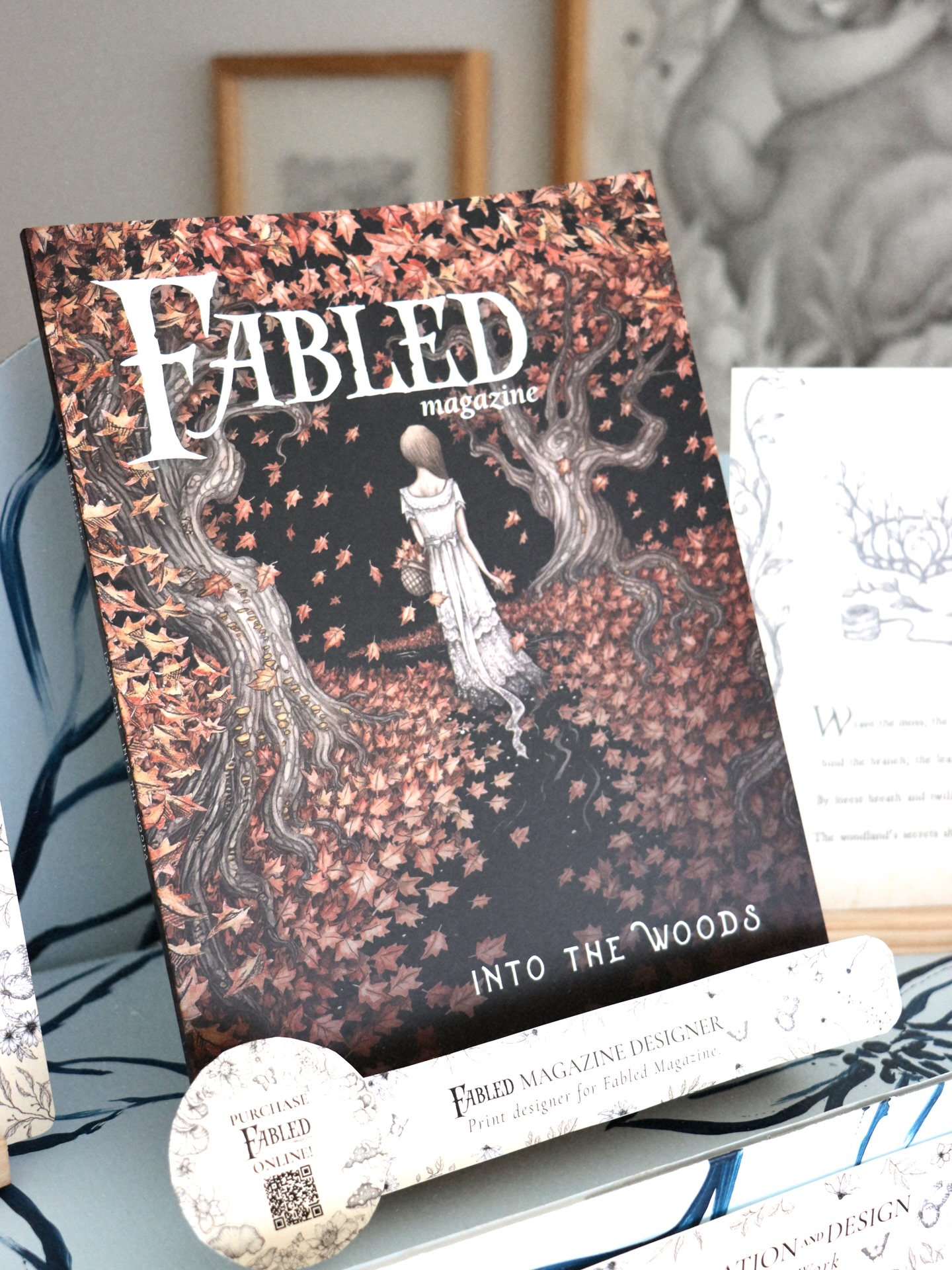
Their first issue, themed Into the Woods, was a success, selling over 300 physical copies alone, and their second issue, Beyond the Pages will soon be published in April, proudly printed by FolioFox and featuring the winner of a writing competition they held with Book Fair Australia (where you would’ve found some of our team members during their Melbourne Event a couple of weeks ago!). Fabled Magazine’s success has so far not only proved that print literary magazines aren’t dead, but that they’re capable of thriving.
To learn a little bit more about how it all began, what it takes to produce a print magazine as an indie creator, and what writers and artists should know about submitting their work to a publication like this, we sat down with Natasa to talk about the vision behind Fabled.
Beyond The Pages of Fabled Magazine
Q: Hey Natasa, thanks so much for joining us! Fabled Magazine has such a beautiful concept and a stunning first issue! Where did the idea for the publication come from? What inspired you to start this magazine related to folklore and fairytales?
Hello! Thank you so much for having me.
Fabled began as an idea that had been slowly forming in the back of my mind for many years. I have always loved to read. In particular, I have always been fascinated by the world of fairytales and folklore. Of traditions and superstitions and how they shape who we are. I often find myself going down rabbit holes, discovering new tales and diving into research for no other reason than for curiosity's sake. This research has aided me in my own writing, but I found I wanted to share the strange and the obscure world of story that lives alongside our own and indeed, within us all in one way or another. We all grew up with stories, no matter where in the world we hail from, stories are ingrained in us. I wanted Fabled to be the kind of publication that brought those stories back to the reader.
I also wanted Fabled to be a place where creatives thrive and where readers can access content that was made with thought, care and most of all, a love for the craft. A reminder that no matter how fast we live or how fast technology moves forward, we will always create and seek to share our creations with the world. My inspiration was simple. I wanted to create a platform for the artist. For the poet. For the dreamers. To provide exposure for emerging writers, those who want their voices to be heard, and this exposure is not based on their follower count or publication history. It is based purely on their craft.
Folklore and fairytales are our focus, but what is at the very heart of Fabled is story. It is through story that we find ourselves and find one another. It is the one thing that brings us together and has since the beginning of time.
We are storytellers, we are collectors of tales in all its many forms. This is the heart of Fabled.
Q: There is so much that goes into one issue of the magazine, that it must be overwhelming! What’s the general process of putting together a magazine like this?
It can most definitely be overwhelming! There have been times where I’ve had to ask myself, ‘What am I doing? Can I do this?’ A lot of work went into the creation of our first issue. But it began well before we even started piecing the issue together. We were starting from scratch and had to navigate our way through so many obstacles. Looking back, I’m not sure how we did it. I am a single mum who works odd hours in an Emergency Department, so time was a major factor.
There just never seems to be enough time. We are a small team, not a big company in an office. Most of Fabled was created during the night when my little one slept. During the quiet hours at work, or stolen moments in between. It was filled with notebooks, endless cups of coffee and papers spread out over the kitchen table. The walls were lined in makeshift spreads so I could get a visual of all 100 pages. The thing is, a project like this cannot be done alone. It requires a dedicated and supportive team who believe in what you’re doing as much as you do. Lana and Lauren, Fabled’s Deputy Editors, and even our in-house artists, Adam Oehlers and Nom Kinnear King, have been here since the very beginning and there are parts of all of us that you see within the pages. Fabled would not be what it is without the wonderful team of creatives who rallied behind us.
Issue 2 was a little less chaotic, and with the successful launch of our first issue, the financial pressure eased. We had enough funds to create a second issue! Yet time was still not on our side. Our designer, Jessica Jane Illustration, met with me and told me that we need a better timeframe or we risk falling too far behind. So not only were we working frantically to get content ready for Issue 2, but we also had to begin on Issue 3 at the same time in order to stay ahead. Two issues a year doesn’t sound like much, but there’s so much that goes into creating a single issue.
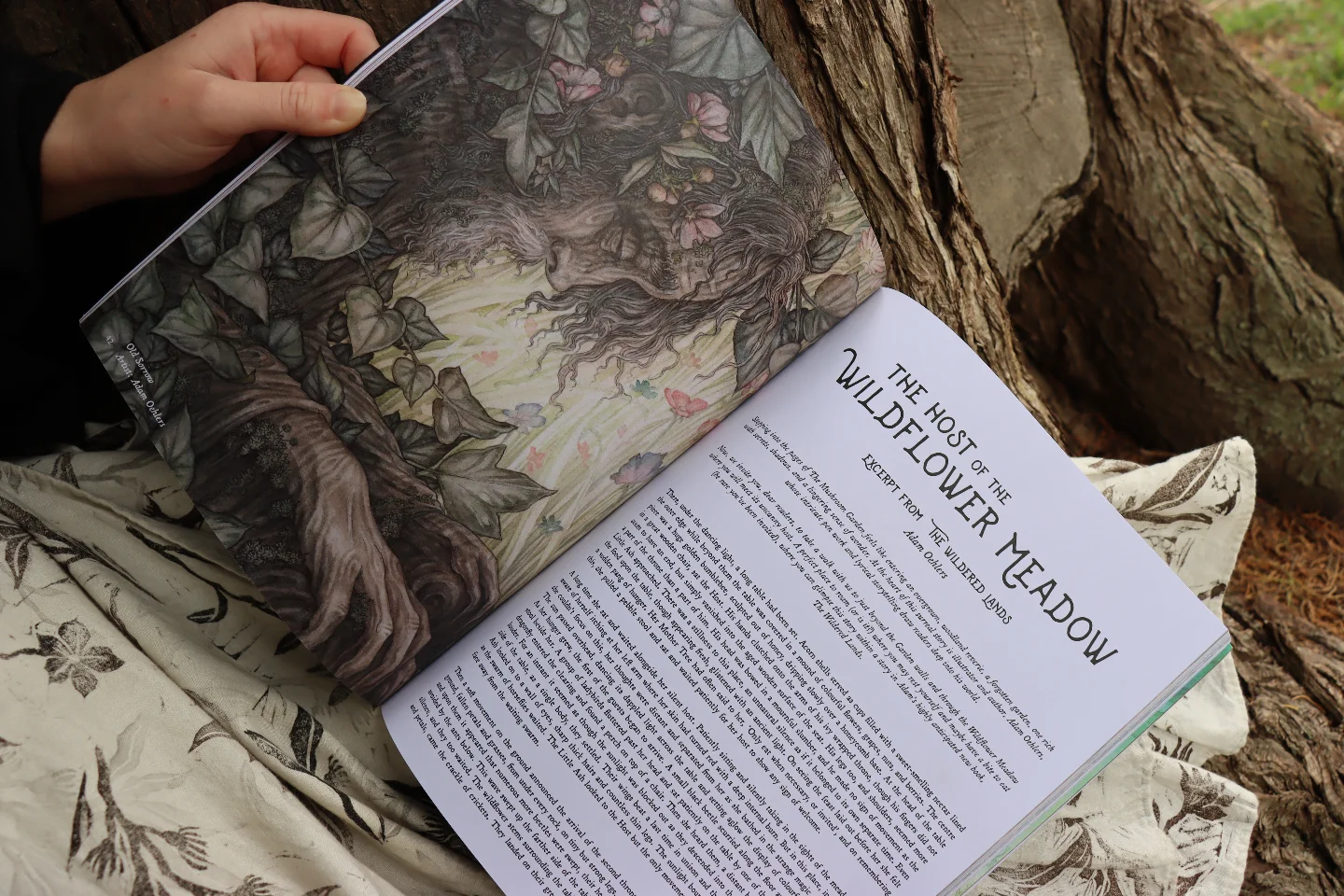
From the writers working on their pitches to the editing process, reading through countless submissions and choosing words and art that all tie in together seamlessly to tell the overall story of our theme. The layout design for each piece, the changes and tweaks that need to be made, all take an immense amount of time. We are lucky to have Jess onboard as our designer, she pieces things together to near perfection and is on top of every email I send her.
To give you an idea of how much work was involved for Issue 1’s design aspect, Jess created a total of 26 volumes before we were ready to take it to print. For issue 2, we are currently at volume 4 and from what I’ve seen, I believe we may only need one or two more revisions before we are ready for print.
This is growth for us. We learnt so much upon launching our first issue. We made many mistakes, including our choice of printer whose prices were terribly high. We learnt from our mistakes, found FolioFox who have been beyond wonderful to deal with from the very beginning with prices that made me almost tear up. Because now, for issue 2, we can lower the retail cost of our magazine for our readers. We can keep creating. So much happens behind the scenes but the one thing I can confidently say is that every single page has been painstakingly, obsessively, and lovingly crafted by so many hands. This is what is so beautiful about Fabled. It is made by humans. Humans who make mistakes, learn from them, and grow.
Q: The next issue of the magazine, Beyond the Pages, sounds very mystical and has the same name as the writing competition and the front cover artwork - which seems so perfect! How did that theme first come about and, in general, how does a theme shape the creative direction for the whole issue?
After our first Issue, Into the Woods, we wanted to go in a whole other direction for Issue 2. The one thing that I say over and over to our team (I’m sure they’re sick of hearing it by now!) and to all our writers is that Fabled’s very core is story. It is something that must always be kept in the back of our minds when considering anything that goes into the pages of an issue. Beyond the Pages was actually Adam and Nom’s idea, something they had mentioned quite a while back. What I didn’t realise until quite recently was that the cover art for Issue 2 shares the same name as our theme and it couldn’t have fit more perfectly.
In fact, when I first told Adam that the name I was considering for our magazine was Fabled, he was so surprised because the cover art I had my heart set on for Issue 1, Wading, was a part of an exhibition at Haven Gallery called Fabled. It all sometimes just aligns beautifully on its own, or perhaps, we are somehow guided subconsciously. I’m not sure. But we have also had yet another connection with the theme of our third issue and one of Nom’s pieces we are considering for the cover. I think it just means we are heading in the right direction, so we’ll continue to follow the path and see where it leads us!
Having each issue themed was important to me from the beginning. Firstly, because I love a good theme! Secondly, and probably most importantly, a theme gives us the vague concept of what to look and plan for, but it is the writer's and the artist's interpretation of the theme that shapes it. That’s been really the most magical thing about these last two issues. The theme is set, but it shifts and changes and grows into something so much more. The overall story emerges as a collective and our job is to piece it together, to ensure that one piece follows into the next to tell a story as a whole rather than separate little stories. It’s one of the things I’ve loved most about the whole process.
Q: Since the magazine has both written works that are both fiction and non-fiction, as well as art, how do you and your team manage to balance the two creative formats? Do you receive submissions from writers and artists that are already collaborating together?
There is a balance between the two, yet what I look for in any submission is creativity. It’s the one thing I stress to all my writers. Make sure it’s not too dry. I look for an element of creative writing in non-fiction because that is what ties it well with the fiction. We have not had a submission yet from a writer and artist who collaborate together, but we have had submissions from people who are both artists and writers and their art and words fit together quite beautifully. Their visual alongside their words is quite a magical pairing. You get to see the mind and vision of the creator on a whole other level, and it can be quite a breathtaking thing.
As to the management, this is where we have now also had to accept that we needed change. We are growing and with growth comes larger tasks to tackle. Our submissions blew up for Issue 2 compared to Issue 1 and we expect that Issue 3 will see even further growth. The one thing that makes me sad in this whole process is that we only have a limited number of pages which means we can only accept a limited number of submissions per issue and those that we accept have to fit the theme and tie in with the rest of the content we have planned. There are so many submissions we have had to decline that I desperately wanted to fit in but just had to accept that I couldn’t at this time. On the other side of this, the thing I love most about what I do is sending those acceptance emails. I smile each time, because the moment I push that send button, I know that someone on the other side has opened that email and it has made their day. This. This is the most important and the absolute best part of what I do at Fabled. Giving authors and artists a platform.
Q: As an author yourself, has being a writer helped you during the process of curating written works by other writers for each issue?
I believe it has. I know what I like and what to look for and more importantly, when it’s not working. Sometimes ideas sound great at the time but once you read through a draft, you realise it’s just not working. And that’s ok! It wasn’t meant to be this time. A rule I made for myself since the very beginning was the rule of three. If a piece still gives me pause for whatever reason after the third draft, it’s time to lay it to rest for now.
At some point you do need to know when to let a piece go. You can go backwards and forwards with a writer but unfortunately, time is something I am always dreadfully conscious of. In the same breath, I’ve had work sent to me by writers that has had me so entranced, there never was a second draft other than some minor tightening. I like to give my writers full creative control. I work closely with them after the first draft if they need me and always make sure they know that I am here to brainstorm with.
As for the submissions we receive, it is Lana [Fabled’s Deputy Editor] that I must thank for this part. While we both read through the submissions carefully, I find that I just don’t have the time to get through them all with all the other work that needs to be done. She reads through them at an uncanny pace (I’ve always been a slow reader) and the most wonderful thing of all is that we see eye to eye on each one. Her style and my own are very similar and we tend to agree with one another on each piece we read through. She also has a keen eye for art. Her world is immersed in it, and I trust her instincts and insights always.
Q: As submissions for Beyond the Pages (Issue #2) are closed, do have any tips for writers and artists considering submitting their work for your next Issue #3? What makes a submission stand out to you?
This is great timing because we have just opened our submission window for Issue 3!
I want to be very honest with this question because I think it’s an important one, especially for anyone who is potentially considering submitting, not only to us at Fabled, but to any publication.
My pet hate is unedited work. A minor error here and there is fine, but a submission full of errors loses my interest entirely and automatically gets discarded. I can’t stress this enough. Do not submit work that you have not gone through line by line to ensure it is up to the best standard it can be. Submit work you can be proud of. A poorly edited piece is hard to follow, it shows a lack of care and in turn, we have no care to read further. We take time to read through your work. Please give the publication you are submitting to the same level of respect.
What does stand out to me is work that has clearly followed our guidelines. We have them in place for a reason so if you blatantly have disregarded most of the requirements, then it feels like a dump submission. By that, I mean that you have sent your work to a stack of publications all at once in the hopes of hearing from one but without taking the time to learn their requirements. This is another automatic discard. Those that follow our guidelines have carefully read, considered and understood our requests. That takes time, yes, but it also shows a level of respect for those who are taking the time to read your work carefully. This really does matter.
Another stand out is that the submission aligns with our theme. This one is quite important as it is the basis upon which we select works. What I love most though, is reading through work that has taken the theme and turned it on its head. Surprised us with their interpretation. We love works that surprise us.
Lastly, words with soul. Depth. Words that make me feel something. This, above all, is what truly makes us accept a submission. Sometimes, there’s a submission that we receive that ticks all those boxes. And we are left with the unfortunate outcome of wanting so badly to accept a piece that we hold on to it till the very last minute in the hopes we can fit it somehow. But the magazine tells a story and sometimes, we just can’t force it to fit. This is hard. Really hard. And I make sure that when we email to decline those exceptional pieces, that the writer knows how we felt about their work, how badly we wished to include it and the reason we couldn’t. This feels important to me. It isn’t just another rejection. I’m just as upset at the limitations we have, and I want the writer to know that.
Q: Contrary to the success of your first issue and the many magazines we continue to print at FolioFox, many people still describe magazines as a dying format. So, why did you choose to print Fabled Magazine, rather than publishing it in a digital-only format?
Because I refuse to allow the digital world to fully take over.
I’ve often been told that print magazines are dying, that digital is taking over and we have to move ahead with the times or be left behind. Yet even with the ever-growing unknown of technology, with more and more people turning to AI and eBooks, I found that what people want most, what people crave most, is the return of simpler times. Creating a publication that was in print form was a must. Yet we also offer the digital option which is a convenient form for our international friends. What we found was that people wanted to hold the physical copy in their hands and our sales reflected that this was the preferred option. Our lives have become accustomed to living in a fast-paced world, yet we crave slow. Fabled is just that. A slowing of time. A treat to enjoy in the stolen moments we carve for ourselves. The slow turning of each page to admire art and words created by humans.
I understand the need for technology and how useful it is as a tool. There are many benefits that we can all acknowledge in one way or another. But it is not a worthy replacement for how the turn of a page, the smell of a book and the snug feeling you get curling up over a good book or magazine feels.
You don’t get the same effect with digital, you just don’t. To provide digital copies only would be doing our magazine and our readers a disservice. I’m old school. I want to hold my book and read my magazines over a cup of coffee in my comfiest chair. I spend enough time on my laptop and phone for work, that I want to be able to separate my pleasures and remove myself from the screen entirely.
And from what I have gained from our audience so far, they too want the same. Print isn’t dying. Our constant pursuit of technology will never go away. But neither will our love for reading printed material. In fact, I believe people are learning to separate the two. Escaping the fast-paced world to return to a slower one.
Q: From a production standpoint, what has been your experience so far in printing and publishing Into the Woods (Issue #1) and is your team doing anything differently for Beyond the Pages (Issue #2)?
Funny you ask that. Printing Issue 1 was a nightmare. Firstly, because my mind doesn’t understand that side of things. It doesn’t work that way. Give me words and I’ll naturally place them together. But printing was a whole other world that I didn’t have the time to try to understand. Lauren actually invested so much of her time with our previous printer and without her knowledge and perseverance, I don’t know if we would have had an Issue 1 to release at all. I can’t thank her enough for this.
While they were good to work with, the cost was terribly high for us. Something we didn’t have a choice but to accept due to the approaching launch date. Once we were in the midst of our Kickstarter, you guys came along, and I thought it was too good to be true! If your prices were to be believed, we could afford to lower the retail price for our readers going forward. This was a huge thing for us. I knew that if we couldn’t lower the retail price for future issues, I didn’t want to continue with this further. It was a lot of money for people, and I wanted physical copies to be more accessible. In my mind, I thought, well, no wonder everyone is turning to digital. They have no choice; it costs a small fortune to print and who can afford to do it?
So, for Issue 2 and indeed, Issue 1 which we will also be reprinting through FolioFox, our price point will now be lowered and Fabled will continue to provide print copies to its readers. This is thanks to you and your incredible team who have been nothing short of wonderful throughout the whole process. You have truly gone over and above for our small press and I’m incredibly grateful. The approach you take to supporting indies is commendable.
Q: Is there anything you wish you'd known more about when going in to print the magazine for the first time? Do you have a piece of advice you’d give to someone that hopes to start their own indie publication?
So much, haha. I don’t know where to start!
I have this terrible habit of diving straight into something and consequences be damned. I take risks, challenge myself constantly and push my own boundaries and limits. If my mind is set on something, there really is nothing that can stop me. But I do wish I took my time more. That I had set aside enough funds first. This one is particularly important. The cost involved is more than I ever thought it would be. To get Issue 1 out was particularly hard as I was going through some major life changes in 2025. It was a difficult year for me, one of the most difficult I’ve faced and Fabled almost didn’t happen at all. But I pushed through with the support of my team. We got there in the end, but I still don’t know how it happened. I’m so proud of that. So proud of what we achieved because Fabled truly was created against the odds.
At the end of it I knew one thing. If we didn’t make enough from the sales to cover the costs of Issue 2, I couldn’t do it again. I couldn’t create another issue, I just didn’t have it in me to try and fund it alone. We were so lucky at the level of love and support we received. Issue 2 was funded, and I felt like I could breathe. I can’t thank our readers enough for this. Because you believed in us, we were able to create a second issue. There’s something so powerful in knowing that.
Get your funds in order and give yourself ample time, because you want your creation to be the absolute best it can be. If you only do half the job, if you cut corners, you will lose your audience, and your potential to grow. Once you commit, you need to commit fully and put everything you have into it. Be original, be daring and fight to get what you want. But be prepared for long hours, emails and phone calls at all hours of the night and those that will try to take advantage when you are just learning how to navigate it all. Most of all, make sure you have a supportive team behind you. People you trust who bring their own voice and flavour to your publication. It cannot just be yours. You cannot do it alone. Most of all, love what you do and do it for the right reasons. Money should not be your main motivator. There is no money making here, right now! Maybe one day, (hopefully!) but not in these early stages so do not let that be your main reason.
Most of all, do not allow anyone to tell you that you won’t succeed. Do allow anyone tell you that you can’t do something that your heart truly wants. As Adam said to me once during a late-night emailing session where I felt just about ready to throw in the towel and pull my hair out: ‘Even if we only create one issue, that’s one issue that’s out in the world. It’s better than none at all.’ And I took heart in those words because he was right. If all I had in me was one issue, then so be it. Turns out, I have two in me so far with a third on the way.
Don’t give up. Especially when things get hard. If you can push through during the hardest times, then you can just about do anything. You are creating something, and that needs to be celebrated. We need more art in the world now more than ever.
Q: We have no doubts that the next issue will be just as, if not more, successful as its predecessor, but what do you hope Fabled Magazine will be able to achieve in 2026 and beyond?
Oh, I hope so!
2026 feels like a good year in so many ways. This year, our aim is to spread the word about our little magazine as much as we can, focus on growth and connect more with our audience to see what they think of Fabled.
We hope to attend more events this year and the next, growing relations with some of our event organisers and building on Fabled one small step at a time. We also want to support our writers and artists more and are seeking new ways to help promote their work and build on this platform for them.
What we truly need is more funds to continue with each issue. We are hoping that Issues 1 and 2 will generate enough sales for us to fund future issues and that more advertisers will come onboard so that we can continue with our work, continue creating and compensating our wonderful creators. We provide support to many, yet we also need support.
If you believe in us, in what we’re doing and creating, consider purchasing an issue, become an advertising partner, buy us a coffee to keep us going or just give us a big old hug. It all goes a long way in ensuring that Fabled continues on. We’ve learnt so much, put so much of ourselves into this and we’re excited to see where it all takes us. And we hope you’ll all be a part of our journey, too.
If you love folklore and fantasy, or simply want to try something new and creative from talented storytellers, check out Fabled Magazine: Into the Woods (Issue #1), available to buy in digital format on their website. To find out about the latest drop of print copies and the launch of Fabled Magazine: Beyond the Pages (Issue #2) coming this April, or information to submit your work for Issue #3, you can follow Fabled Magazine on Instagram.
When it comes to bringing your own work to life in print, we’re here to help! Request a quote or get in touch with us, to get started on bringing for your next novel, magazine or literary publication to life in print.
Hero image: courtesy of Fabled Magazine.